FOR MARKETPLACE FOUNDERS
Most Marketplace Startups Don't Fail Because of Bad Ideas. They Fail Because They Build the Wrong First Version.
If your MVP can't prove that people want to transact, it isn't reducing risk—it's creating more of it. Use the Marketplace MVP Blueprint to define a lean, validation-focused MVP before you write a single line of code.
30-Day "Build With Confidence" Money-Back Guarantee
✦
THE REAL PROBLEM
You Didn't Set Out to Build Too Much.
It Just Happened One "Essential" Feature at a Time.
You started with a simple marketplace idea.
Then came user accounts. Messaging. Reviews. Ratings. Payments. Dashboards. Notifications. Admin tools.
Before long, your "minimum" product started looking suspiciously like the finished version of Airbnb or Upwork.
Meanwhile, the one question that actually determines whether your marketplace has a future is still unanswered:

Will buyers and sellers actually transact if you put them together?
That's why so many marketplace founders spend months planning, designing, and building—only to discover they validated software instead of validating the business.
The advice doesn't make it any easier.
One expert tells you to launch fast. Another says you need more features to compete. Another tells you to copy successful marketplaces because "that's what users expect."
So you keep adding. Keep refining. Keep delaying the moment when real users can prove whether the idea works.
The frustrating part? It feels productive. Until you realize you've invested months of time and a significant budget without reducing the biggest risk your marketplace faces.
✦
THE SHIFT
The Marketplace Isn't the Product.
The Transaction Is.
Imagine two founders. Both launch an MVP with the same budget.
The first builds user profiles, messaging, reviews, notifications, advanced search, and a polished dashboard.
The second builds only what's necessary for one buyer and one seller to successfully complete a transaction.
Six months later, only one of them knows whether they have a real business.
Marketplace startups aren't validated when the software works. They're validated when strangers repeatedly choose to transact through the platform.
A SaaS founder can validate whether one customer finds value in a product. A marketplace founder has to prove something much harder:
Can both sides of the marketplace show up at the same time, create value for each other, and keep doing it?
That's where most founders lose their way. They treat feature development as progress when the real objective is reducing uncertainty.
Before worrying about ratings, AI recommendations, referral systems, or dozens of other "must-have" features, you first need answers to questions like:
Which side of the marketplace is harder to acquire?
What is the smallest transaction that proves the idea works?
Which assumptions actually need validation before writing more code?
When you have those answers, building becomes dramatically simpler. Because you're no longer guessing what belongs in your MVP—you're building only what's necessary to prove your marketplace deserves to exist.
✦
INTRODUCING
You Don't Need Another MVP Framework.
You Need One Built Specifically for Marketplaces.
Introducing the Marketplace MVP Blueprint.
A practical workbook for marketplace founders who want to validate their idea before committing months of development time and a significant budget.
The Marketplace MVP Blueprint helps you replace assumptions with decisions. Instead of wondering which features belong in your MVP—or copying what established marketplaces have today—you'll define the smallest version of your marketplace that can validate whether buyers and sellers are actually willing to transact.
This isn't another startup theory book. It's not a generic product planning template. And it's definitely not a checklist that encourages you to build everything before launch.
It's a structured blueprint that walks you through the critical decisions marketplace founders need to make before a developer writes the first line of code.
WHAT'S INSIDE
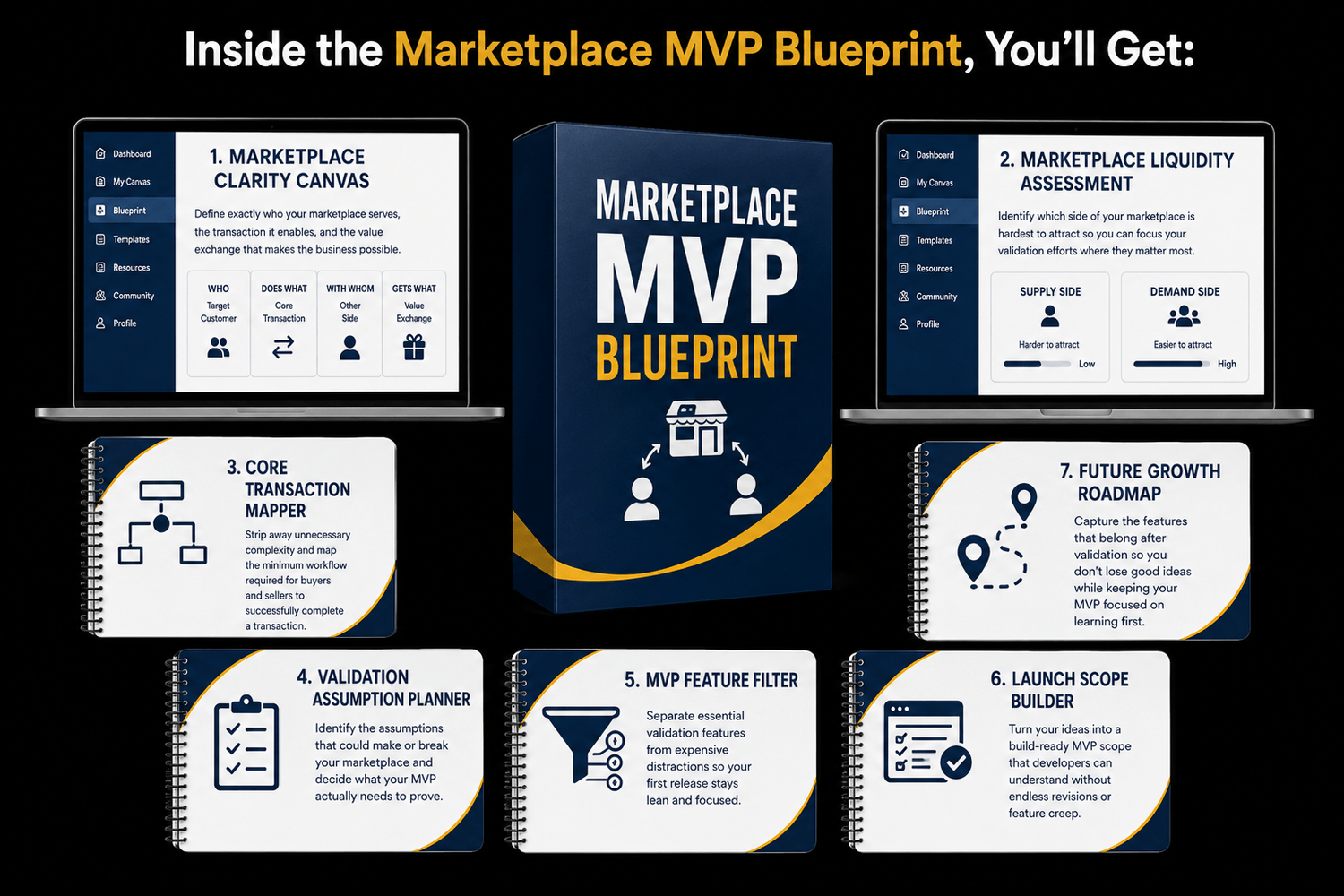
Inside the Marketplace MVP Blueprint,
You'll Get:
1
Marketplace Clarity Canvas
Define exactly who your marketplace serves, the transaction it enables, and the value exchange that makes the business possible.
2
Marketplace Liquidity Assessment
Identify which side of your marketplace is hardest to attract so you can focus your validation efforts where they matter most.
3
Core Transaction Mapper
Strip away unnecessary complexity and map the minimum workflow required for buyers and sellers to successfully complete a transaction.
4
Validation Assumption Planner
Identify the assumptions that could make or break your marketplace and decide what your MVP actually needs to prove.
5
MVP Feature Filter
Separate essential validation features from expensive distractions so your first release stays lean and focused.
6
Launch Scope Builder
Turn your ideas into a build-ready MVP scope that developers can understand without endless revisions or feature creep.
7
Future Growth Roadmap
Capture the features that belong after validation so you don't lose good ideas while keeping your MVP focused on learning first.
By the time you finish the blueprint, you won't just have a list of features. You'll have a clear, validation-focused plan for building the smallest marketplace capable of proving your business idea deserves to move forward.
✦
Ready to stop guessing and start validating?
Build with clarity before you build with code.
Get instant clarity before you commit to development.
30-Day "Build With Confidence" Money-Back Guarantee
✦
THE FRAMEWORK
You Don't Need More Discipline.
You Need a Better Decision Filter.
The Marketplace MVP Blueprint is built around one simple principle:
Every decision should reduce uncertainty before it increases development.
Instead of asking, "What else should we build?" you'll learn to ask, "What must we prove before this deserves to be built?"
That shift changes everything.
THE VALIDATION-FIRST FRAMEWORK
Three Steps. One Outcome: Clarity.
01
Define the Marketplace That Actually Needs Validation
Clarify your buyers, sellers, core transaction, and the assumptions your business depends on. Before features enter the conversation, you'll know exactly what your marketplace must prove.
02
Design the Smallest Marketplace That Can Prove It
Map the essential user workflows, identify the features that directly support validation, and confidently eliminate everything that can wait.
03
Create a Build-Ready MVP Scope
Organize your MVP into a clear launch plan with defined user roles, pages, integrations, success metrics, and a future roadmap—so development starts with clarity instead of constant revisions.
You don't need years of product management experience. You don't need to predict every feature your marketplace will eventually need. And you don't need to build a platform that looks like Airbnb, Uber, or Fiverr on day one.
You simply follow the blueprint, complete each exercise in order, and let every decision bring you closer to answering the one question that matters most:
Is this marketplace worth building?
That's why the goal of the Marketplace MVP Blueprint isn't to help you launch with more features. It's to help you launch with more confidence.
✦
WHY THIS IS DIFFERENT
Good Marketplace Decisions Come From a Clear Validation Process—
Not Better Guesswork.
There isn't a shortage of advice for startup founders. There are books on Lean Startup. Articles about MVPs. Videos explaining product-market fit. Countless feature lists from successful marketplaces.
The problem is that most of it treats marketplaces like any other software business. They aren't.
A marketplace only succeeds when two different groups of people repeatedly create value for each other. That introduces challenges most product frameworks barely touch—questions like marketplace liquidity, balancing supply and demand, identifying the core transaction, and deciding which assumptions need validation first.
That's exactly what the Marketplace MVP Blueprint is designed to help you work through. Rather than handing you a generic checklist, it guides you through a logical sequence of decisions that build on each other.
By the time you reach the end, you've clarified who your marketplace serves, what your MVP must validate, which features are essential, and what can confidently wait until later.
The result isn't just a shorter feature list. It's a stronger foundation for every conversation you'll have with developers, co-founders, investors, or advisors.
✦
IMAGINE
Imagine Starting Development Knowing
Exactly What You're Building—and Why.
Picture yourself sitting down with a developer. Instead of saying, "I think these are the features we need," you're confidently walking through a clear MVP scope.
You know who your first buyers are
You know who your first sellers are.
You know the single transaction your marketplace must facilitate.
You know which assumptions your MVP is designed to validate.
And just as importantly, you know which features can wait.
That clarity changes everything.
Development conversations become shorter. Budgets become easier to control. Feature creep becomes much harder to justify. Every decision has a purpose because every feature supports validation.
More importantly, you stop carrying the constant doubt that every marketplace founder wrestles with: "What if I'm building the wrong thing?"
Instead, you move forward knowing your first version has one job—to tell you whether your marketplace deserves further investment.
The biggest win at the idea stage isn't launching the biggest marketplace. It's gaining the clarity to make your next decision based on evidence instead of hope.
✦
THE COST OF DELAY
Every Month You Delay Validation,
You're Investing in Assumptions.
Building a marketplace is expensive. Not just because of development costs.
Because every extra week spent building features before validating your core marketplace increases the chance that you're solving the wrong problem.
A few "nice-to-have" features become dozens. A few weeks become several months. A manageable budget grows into a much larger investment.
And after all that time and money, you're still waiting for the only answer that really matters: Will buyers and sellers actually use this marketplace?
The Marketplace MVP Blueprint isn't an expense added to your project. It's a decision-making tool that helps you avoid building functionality before you've earned the right to build it.
The most expensive feature isn't the one that costs the most to develop. It's the one you never needed to build in the first place.
✦
30-DAY GUARANTEE
Build With Confidence—Or Don't Keep It.
Work through the Marketplace MVP Blueprint from beginning to end. Complete the exercises, define your marketplace, map your workflows, prioritize your MVP features, and build your launch scope.
If, within 30 days, you genuinely feel it didn't give you substantially more clarity about what your marketplace should—and shouldn't—include in its first release, simply request a refund. No complicated conditions. No endless back-and-forth.
✦
A YEAR FROM NOW
You'll Either Have Answers—
Or a More Expensive Version of the Same Questions.
Imagine looking back twelve months from today. Your marketplace is finally live. But instead of wondering whether people will use it, you're watching real buyers and sellers complete real transactions. Every improvement you make is based on actual user behavior—not assumptions you made before launch.
Now imagine the alternative.
Another year spent adding features. Another round of revisions because someone suggested "just one more thing." Another development milestone reached without knowing whether your marketplace solves a problem people care enough to act on.
The difference between those two futures isn't who writes better code. It isn't who has the bigger budget. It starts much earlier—with the decisions you make before development begins.
Your first version doesn't have to impress the market. It has to teach you something the market can answer.
Successful marketplace founders aren't the ones who launch with the most features. They're the ones who learn the fastest, adapt the earliest, and earn the confidence to keep building because real users have already shown them they're headed in the right direction.
If you're serious about turning your marketplace idea into a real business, don't begin by building a bigger product. Begin by building the right first version.
✦
FINAL STEP
Your Marketplace Deserves More Than a Feature List.
It Deserves a Validation Plan.
You've already done the hard part. You identified a problem worth solving.
Now make sure the first version of your marketplace is designed to answer the questions that matter most—before months of development, feature requests, and budget decisions lock you into the wrong path.
The Marketplace MVP Blueprint will help you define a lean, build-ready MVP focused on validating your business instead of expanding your feature list.
Clarify your marketplace concept
Map your buyer and seller workflows
Prioritize only the features that support validation
Create a build-ready MVP scope
Develop with confidence instead of assumptions
Stop building for possibilities. Start building for proof.
Get instant clarity before you commit to development.
30-Day "Build With Confidence" Money-Back Guarantee
✦
FAQ
Common Questions
That's exactly who this blueprint is for. You don't need a polished business plan or complete specifications. You only need an idea you're serious about exploring. The workbook helps you turn that idea into a structured, validation-focused MVP.
Yes. The exercises are designed specifically for two-sided marketplaces where buyers and sellers create value by transacting through the platform. It's intentionally different from generic MVP or startup planning resources.
No. The blueprint focuses on business and product decisions, not programming. It's written to help non-technical founders make better planning decisions before speaking with developers.
No. It tells you what should be built first and what can wait. Once you've completed the blueprint, you'll have a much clearer MVP scope to guide technical planning and development.
Perfect. One of the biggest goals of this workbook is helping you separate essential validation features from everything that can be postponed until after you've proven the marketplace works.
Most founders can work through the blueprint in a few focused sessions. Because it's a workbook, the pace depends on how much thought you put into each decision.
Absolutely. In fact, you'll get even more value from it. A clear MVP scope leads to better conversations, fewer misunderstandings, less feature creep, and more accurate development estimates.
That's a good outcome. The purpose of the blueprint isn't to lock you into your first idea—it's to help you uncover better decisions before investing heavily in development. Discovering a better direction on paper is far less expensive than discovering it after your product is built.
© Marketplace MVP Blueprint. All Rights Reserved.